Showing posts with label use of English. Show all posts

Friday, 13 September 2013

30 Common mistakes at FCE Part 3

                                 Common mistakes at First Certificate


11. Make or do?


12. Find out, make up, bring up, grow up or take off?


13. Like or as?


14. Which common nouns are uncountable?


15. Good or Well?


16. When do we use an apostrophe?


17. When do we use a capital letter and a comma?


18. What are some common spelling mistakes?


19. Confusing nouns


20. Confusing adjectives


Learn&Share
 Chú ý: Nếu chữ trong bức hình quá nhỏ, bạn click chuột vào bức hình để phóng to và xem nhé!


30 Common mistakes at FCE Part 2

                                 Common mistakes at First Certificate


6. When do we use past perfect?


7. Must or Have not


8. Mustn't or don't have to


9. Can, Could, Couldn't or Be able to


10. Say or tell


Learn&Share         
 Chú ý: Nếu chữ trong bức hình quá nhỏ, bạn click chuột vào bức hình để phóng to và xem nhé!


30 Common mistakes at FCE Part 1

                             Common mistakes at First Certificate

        Đây là 30 lỗi mà người thi FCE hay nhầm lẫn và thường mắc phải.
  1. 1. Can We use the future after when or if?


2. How can We use present tenses to talk about the future?
                            

3. How do we form indirect questions?


4. Have or Have Got?


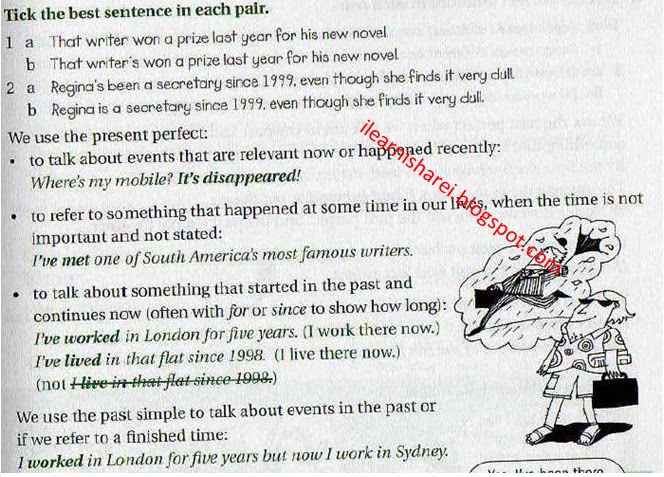
5. When do we use the present perfect?


Learn&Share
 Chú ý: Nếu chữ trong bức hình quá nhỏ, bạn click chuột vào bức hình để phóng to và xem nhé!


Thursday, 12 September 2013

Use Of English Part 3 - Word Formation

                                   Word Formation - Use Of English Part 3

       Phần này, bạn sẽ đọc một đoạn text ngắn khoảng 200 từ, có 10 chổ trống. Cho mỗi chổ trống bạn phải sử dụng những từ cho sẳn để điền vào sau cho phù hợp. Phần này kiểm tra bạn cách mà từ ngữ được hình thành trong tiếng anh, bao gồm prefixes và suffixes, và spelling rules. Kết quả điền vào answer sheet.

       Để làm tốt phần này bạn cần biết:
  • Forming nouns from verbs, nouns, adjectives. For examples:
           A person who acts for a living is called an .....( actor: Yes!)
           A.....is someone who earn money from writing music. (>>>musician)
           My teacher says there has been a big (improve).....in my English lately. (>>>improvement) 
  • Forming opposite meanings: you can also notice the prefixes and suffixes which used to form opposite words. Examples:
                        'honest' vs 'dishonest', care - careless, legal - illegal, etc.
  • Forming verbs
  • Forming adjectives and adverbs 
  • Difficult Spellings:    Examples:
                 He was the (big)....in the class.
                       A. biggest
                       B. bigest
               You don't need to wear a suit to the party. You can look (formal)....if you wish.
                       A. imformal 
                       B. informal 

           Cách học
  •  When you make a note of  new words try to record all its different forms (verbs, nouns, adjectives, adverbs) 
  • Try tests, practice and practice!
       Learn&Share 


Wednesday, 11 September 2013

Use of English Part 4 - Key Word Transformations

                      Key Word Transformations - FCE Use Of English 
    Trong phần này, bạn được đưa một câu hoàn chỉnh và theo sau là một câu không hoàn chỉnh. Bạn phải hoàn thành câu thứ 2 sau cho nó có nghĩa giống với câu 1 với điều kiện sử dụng từ đã cho sẳn. Phần này có 8 câu hỏi tất cả. Phần này kiểm tra bạn cả từ vựng và ngữ pháp. Đáp án chuyển sang answer sheet.

    Trong phần này bạn cần quan tâm đến:
  • Comparatives/Superlatives: structures like so/such..., too/enough, as...as, ..er...than, etc often appear in this part.
  • Passive: Change from active to passive or passive to active are often required
  • Direct and Indirect Speech: sometimes, you are asked to transform a sentence from direct speech to indirect speech or from indirect speech to direct speech.
  • Auxiliary verbs: Verbs like 'will', 'have', 'must', 'need; etc, are often tested in this part also.
  • Conditionals: any type of conditional sentence is likely to appear in this part
  • 'Unreal' past tenses: sometimes you will find sentences using 'If only...','I wish...', I'd rather...,etc that require the use of past tenses.
  • Verb Patterns: you can be tested your knowledge of verb patterns such as gerund and infinitive.
  • Phrasal verbs 
     How to improve
  • If you get a sentence wrong, rewrite the correct structure in a way that has personal meaning.
  • Try to practice as much as possible!
        Learn&Share


Use Of English Part 2 - Open Cloze

                           Open Cloze - Use Of English Part 2
     Trong phần này bạn sẽ đọc một đoạn text ngắn trong đó có 12 chổ trống. Bạn phải điền từ phù hợp vào mỗi chổ trống đó. Tương tự phần 1, đáp án phải được chuyển vào phiếu trả lời (answer sheet). Phần này chủ yếu kiểm tra bạn về mặt ngữ pháp.

      Để làm tốt phần này các bạn cần nắm:

  • Parts Of Speech: The missing word is often one of the parts of the speech (relative pronoun, preposition, pronoun, conjunction, article, modal verb, etc). Knowing which part is missing will help you to choose the correct answer.
  • Pronouns/Relative pronouns: words like 'you', 'her', 'who', 'which', 'that',... are often the missing word.
  • Prepositions: 'in', 'at', 'on', 'from', etc. will very often be the missing word. You may aslo find that either the verb or the prepotition of a phrasal verb is gapped.
  • Articles/Quantifiers: 'a', 'the' and quantifiers like, 'much', 'many', 'all', 'enough', etc. are often required
  • Modal/Auxiliary Verbs: Verbs like 'must', 'can', 'be', and other model verbs or auxiliary verbs are often missing words.  
  • Conjunctions: 'but', 'and', 'yet', etc. will sometime be the word you are looking for.
      Nên và không nên
  • Nên nhìn phần text trước và cả sau chổ trống.
  • Nên viết đáp án rõ ràng vào answer sheet
  • Không nên bỏ trống đáp án, trong trường hợp không biết đáp án, bạn cũng có thể đoán.
      Cách cải thiện
  • Nắm vững từng loại từ kể trên và cách sử dụng chúng. 
  • Try tests, luyện tập, luyện tập và luyện tập!
          Learn&Share


Use of English Part 1 - Multiple Choice Cloze

                                 Multiple Choice Cloze - Use Of English Part 1 
      Trong phần này bạn sẽ đọc một đoạn text ngắn trong đó có 12 chổ trống. Mỗi chổ trống nhiệm vụ của bạn là phải chọn từ cần điền vào từ một trong 4 lựa chọn A, B,C,D có sẵn. Sau đó chuyển đáp án đó vào phiếu trả lời (answer sheet).

      Để làm phần thi này tốt thì bạn cần nắm rõ những vấn đề sau:
  • Synonyms: You should be able to identify the correct word from a selection of similar words that matches a particular context or goes with another word.   
  • Collocations: You will need to be able to identify common collocations, that is words that go together. For example: 
                     You do your homework
                     You make the bed
  • Phrasal Verbs: Phrasal Verbs are frequently tested in Part 1 (this part). You need to look out for missing verbs or prepositions/particles. 
  • Expressions, Idioms: You will need to be able to identify common collocations, that is words that go together. For examples: 
                   'on no account', 'take it easy', 'put up with', etc.
              Xêm thêmtại đây
  • Linking WordsPhrasal Make sure you know the difference between the common linking words used in English. 
                   Examples: 'despite' vs 'although', etc.
             
    Nên và không nên làm gì trong phần này
  • Nên nhìn phần đoạn text (từ ngữ) trước và sau chổ trống.
  • Không nên để đáp án trống, hoặc bỏ không làm câu nào.
  • Nên đoán trong trường hợp bạn không biết đáp án đúng
   Cách cải thiện phần Multiple Choice Cloze
  •  Phrasal Record phrases, not just individual words, in your vocabulary notebook.
  • Try tests, practice, practice and practice!
Xem tiếp phần 2 tại đâyUse Of English Part 2

Learn&Share 


FCE Use Of English

                                 Tổng quan về phần thi FCE Use Of English 

        Phần thi Use Of English gồm 42 câu hỏi, trong khoảng 45 phút, kiểm tra bạn chủ yếu về ngữ pháp và từ vựng. Nó chia làm 4 phần:
  •  Part 1: Multiple Choice Cloze
  • Part 2: Open Cloze
  • Part 3: Word Formation
  • Part 4: Key Word Transformations

 Multiple Choice Cloze
     Trong phần này bạn sẽ đọc một đoạn text ngắn trong đó có 12 chổ trống. Mỗi chổ trống nhiệm vụ của bạn là phải chọn từ cần điền vào từ một trong 4 lựa chọn A, B,C,D có sẵn. Sau đó chuyển đáp án đó vào phiếu trả lời (answer sheet).
    Xem thêm tại đâyUse Of English Part 1

Open Cloze
     Trong phần này bạn sẽ đọc một đoạn text ngắn trong đó có 12 chổ trống. Bạn phải điền từ phù hợp vào mỗi chổ trống đó. Tương tự phần 1, đáp án phải được chuyển vào phiếu trả lời (answer sheet). Phần này chủ yếu kiểm tra bạn về mặt ngữ pháp.
   Xem thêm tại đâyUse Of English Part 2

Word Formation
    Phần này, bạn sẽ đọc một đoạn text ngắn khoảng 200 từ, có 10 chổ trống. Cho mỗi chổ trống bạn phải sử dụng những từ cho sẳn để điền vào sau cho phù hợp. Phần này kiểm tra bạn cách mà từ ngữ được hình thành trong tiếng anh, bao gồm prefixes và suffixes, và spelling rules. Kết quả điền vào answer sheet.
    Xem thêm tại đây: Use Of English Part 3

 Key Word Transformations
    Trong phần này, bạn được đưa một câu hoàn chỉnh và theo sau là một câu không hoàn chỉnh. Bạn phải hoàn thành câu thứ 2 sau cho nó có nghĩa giống với câu 1 với điều kiện sử dụng từ đã cho sẳn. Phần này có 8 câu hỏi tất cả. Phần này kiểm tra bạn cả từ vựng và ngữ pháp. Đáp án chuyển sang answer sheet.
   Xem thêm tại đây: Use Of English Part 4
    
                                                                                                                           Learn&Share
Tuesday, 10 September 2013

Tips For FCE - Mẹo tự học FCE

  HOW TO REVISE FOR FCE
It is important to use the time that you have to revise for FCE as well as possible. Here are some ideas to help you do this.

  • Make your plan: Think about
                  + What you need to do to prepare for the exam
                  + How much time you have
                  + How you can fit what you need to do into that time
  • Think about what you need to know: You must know exactly what you will have to do in the exam. What FCE is all about. Think about what you need to improve.
  • Have what you need in hand: In order to prepare for FCE you may need: 
                  + a good learner's dictionary (with examples of how words are actually used in English)
                  + an FCE - level coursebook
                  + some examples of FCE papers
                  + a vocabulary notebook
                  + a bilingual dictionary
                  + a good grammar book
  • Think about when and where you study
  • Organize your revision time well and enjoy your revision
     READING
   The more you read in English before the exam, the better you will do. Reading is the best way to improve your grammar and vocabulary. You may want to read newspapers, film reviews, stories, books, but remember don't look up every word in a dictionary when you read as this will spoil your pleasure in reading. Just look up anything that is essential for understanding. Then when you have finished you can go back and look up some more words and make a note.
    Keep a reading diary. It will help you to use some of the language for what you have this.
    WRITING
   It is important to practice Writing regularly in English. 
           + Use some of new vocabulary and expressions that you have learned from reading
           + Ask someone (a teacher or native English speaker) to correct your work if possible

    USE OF ENGLISH
      Doing practice test will help you most in this. You also need to have a good control of grammar and vocabulary to do well.

   LISTENING
       There are lots of ways and things you can listen to.
           + Listen to the news in English on radio or on an English - language TV channel as much as possible
           + Watch DVDs of English-language films.
           + Listening to songs in English can be an enjoyable and relaxing way of listening to English 
    SPEAKING
       Make the effort to practice speaking English whenever you can
        + Get together with friends and agree that you will speak only English for half an hour.
        + Join an English language club if there is one in your area.
        + Try to make contact with English speakers visiting your area.
        + When listening to English - language films or televisions, think about the language that speakers use and make use of it when you are speaking yourself.
       + Make sure you can talk about yourself, give opinions, ask someone to repeat or explain, agree or disagree. You may need to do all of these things in the exam.

       Hope these ideas will help you.
      Chúc các bạn tự học FCE và thi đạt kết quả tốt!

Xem download các tài liệu FCE tại đây: Tai lieu FCE

Learn&Share